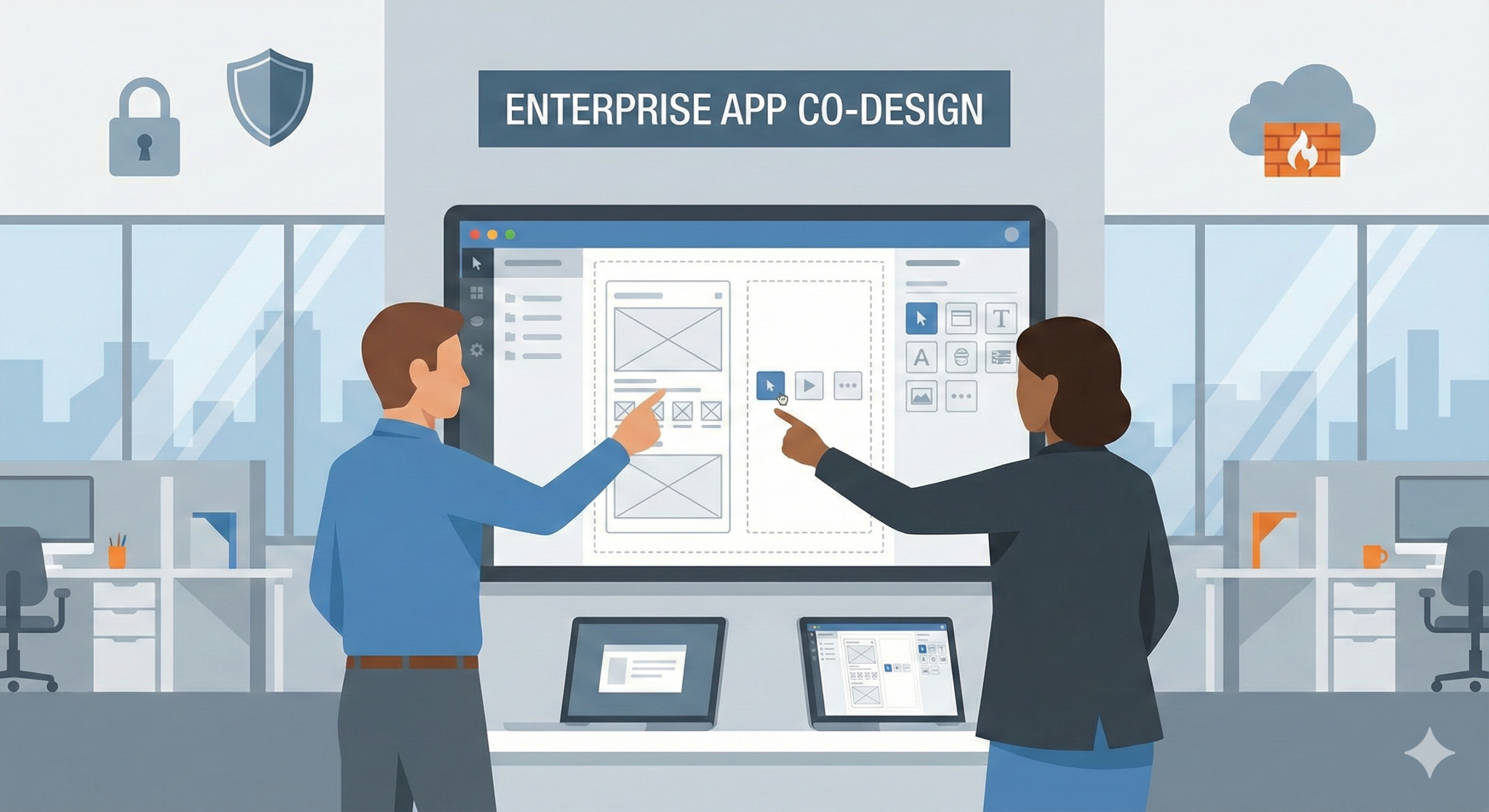
For years, no-code tools were seen as the domain of startups and hobbyists – great for prototypes and side projects, but not something a serious enterprise would bet on. In 2025, that perception is increasingly out of date.
Large organisations are quietly embracing no-code and low-code platforms as part of their mainstream technology stack. Not to replace core systems, but to close the endless gap between what the business needs and what the IT backlog can deliver.
The logic is simple. Business teams face real problems today: awkward spreadsheets, manual approvals, workarounds for missing features in major systems. Traditional development approaches can’t keep up. Even with large IT departments, there are more requests than capacity.
No-code offers a way to match the pace of change. Instead of waiting months for a new internal tool, a product ops team or finance manager can build and iterate it themselves, within guardrails set by IT. Done well, this reduces shadow IT and improves governance, rather than worsening it.
There are three main enterprise use cases where no-code shines.
First, internal apps and workflows. Think of all the small tools that glue bigger systems together: portals for partners, onboarding checklists, approval flows, simple CRMs for niche teams. These rarely justify full-scale custom builds but are painful to live without. No-code platforms allow teams to design, test and refine such tools in weeks.
Second, automation. Tools like Make, Zapier for Enterprise, and native low-code features in Microsoft and Salesforce ecosystems let you orchestrate actions across systems: updating records, sending notifications, generating documents. These automations are easier to build and maintain when domain experts can change logic themselves.
Third, experimentation. Innovation teams need to test ideas with users quickly, long before there’s a business case for major investment. No-code is perfect for building realistic prototypes and “concierge” services that feel like full products, using a fraction of the time and budget.
Of course, enterprise adoption comes with legitimate concerns. Security, data privacy, access control and maintainability all matter more when you operate at scale.
The answer isn’t to ban no-code; it’s to domesticate it.
That means choosing tools that support enterprise requirements: single sign-on, fine-grained permissions, audit logs, data residency options and robust APIs. It means setting standards: which platforms are approved, how they connect to core systems, and how solutions move from “experiment” to “supported service”.
It also means rethinking roles. The term “citizen developer” is overused, but the concept is sound: motivated business users who can build within a structured environment, supported by IT. Rather than seeing them as a threat, successful enterprises treat them as an extension of the delivery team.
Governance is critical. You don’t want a sprawl of unmaintained apps built by people who leave the company. Establish life-cycle rules: every app must have an owner, documentation, and a review cadence. Decide thresholds at which responsibility shifts – for example, once usage or risk crosses a certain level, an app is formally adopted and supported by IT.
Culturally, there’s work to do on both sides. IT teams need to move from gatekeeping to enablement, providing patterns, shared components and training. Business teams need to accept that not everything can or should be done “their way” if it conflicts with security or architecture principles.
The reward is a more responsive organisation. When a regulation changes, you can adjust forms and workflows quickly. When a new product launches, sales support tools appear in weeks, not quarters. When a team identifies a bottleneck, they can test a solution rather than just complaining about it.
No-code won’t replace enterprise engineers. In fact, it often makes their work more impactful by removing low-level requests and letting them focus on high-value problems: platform design, performance, complex integrations, and security. Think of no-code as an additional layer in the stack, not a competitor.
In short, no-code has grown up. It’s no longer just for startups trying to get their first product out. Used thoughtfully, it’s a powerful way for enterprises to unlock the creativity of their people, reduce shadow IT, and respond faster to a changing world.