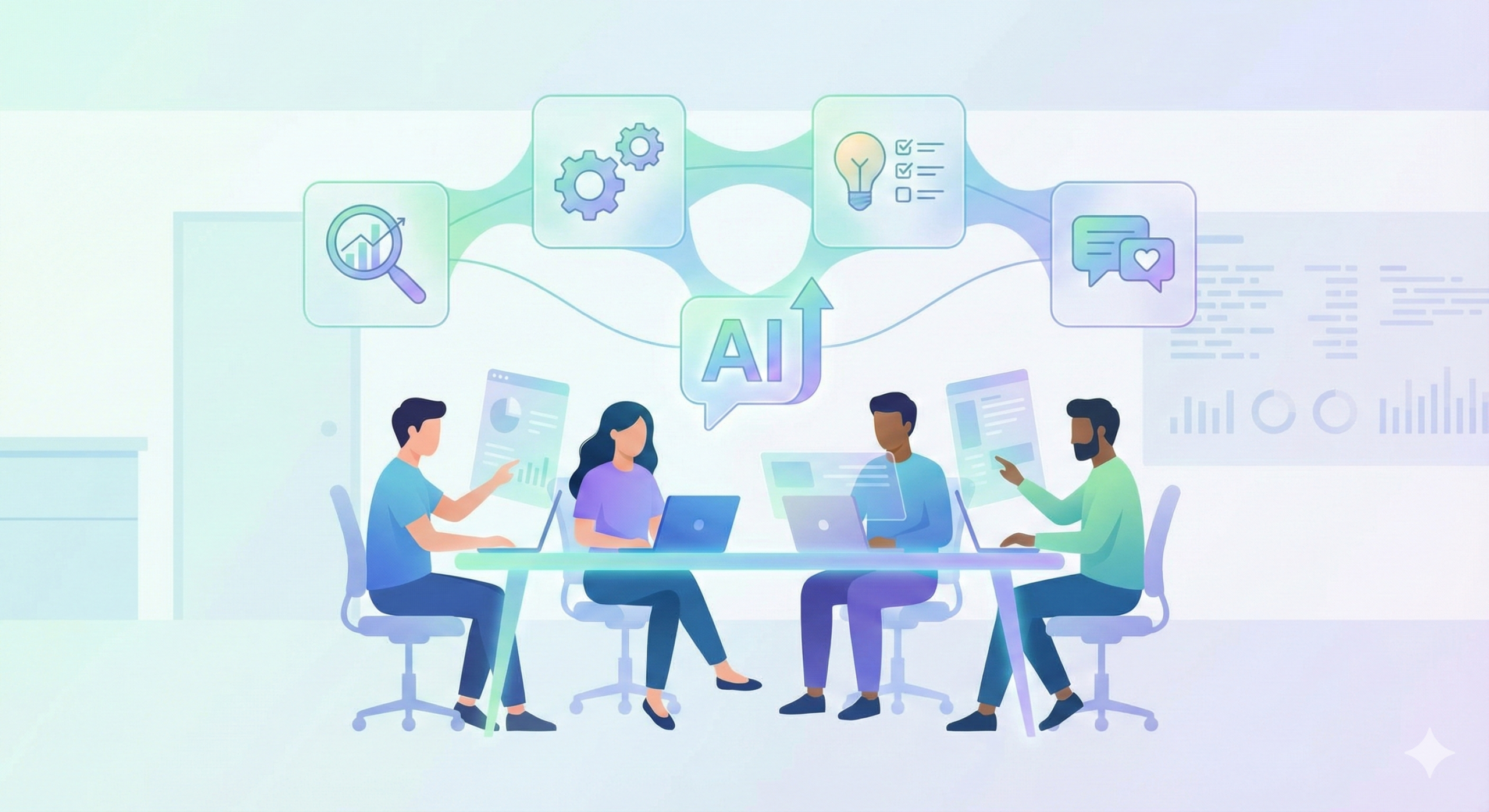
For a long time, there was an unspoken rule in tech: if you couldn’t write code, you needed either a technical co-founder or a lot of money. Having a strong product sense, domain experience or a good network wasn’t enough. You still had to convince someone to turn your ideas into working software.
That rule is breaking down.
Between mature no-code platforms, AI-assisted app builders and what I call Vibe coding – building by describing intent, flows and UX instead of wrestling with syntax – founders now have a third option. You can move from idea, to prototype, to paying users without hiring a traditional engineering team up front.
In my guide to Vibe coding, I talk about this shift in more detail. In my comparison of AI app builders like Lovable, Bolt, v0 and Replit, I look at the tools. This article is about the mindset: how to think about no-code as a founder, where it shines, when it hurts, and how to move gracefully from scrappy prototypes to robust products.
Why no-code isn’t “cheating”
There’s still a lingering idea in some circles that no-code is somehow less serious. You hear lines like “we’ll rebuild it properly later” or “real products are built with real code”. Underneath that is a misconception about what “real” software looks like in 2025.
Everything sits on abstractions now. Frameworks hide huge amounts of complexity; platforms like Stripe, Auth0 or Supabase remove whole categories of work that used to consume entire teams. No-code tools are simply further along that same spectrum. They trade low-level control for speed and accessibility.
What matters is not how “pure” your tech stack is, but how quickly you can learn. In The Build Trap: Why Custom Coding Your MVP Is Financial Suicide in 2025, I argue that the biggest danger at early stage is over-building something nobody needs. If no-code lets you put a working version of your idea in front of customers in weeks instead of months, that is not cheating. It is good product practice.
The new landscape: tools that meet you where you are
When people say “no-code”, they often mean older generations of tools that focused on simple CRUD apps and marketing sites. Those still matter, but the landscape is broader now.
You have visual platforms like FlutterFlow and Bubble, which I unpack in FlutterFlow vs Bubble: The 2025 No-Code Stack for Non-Technical Founders. You also have AI-driven builders that feel closer to a conversation than a canvas. In Comparing AI App Builders: Lovable vs Bolt vs v0 vs Replit, I show how you can describe a flow or a feature in natural language and have the system generate screens, logic and basic styling.
This is where Vibe coding comes in. Instead of thinking in terms of classes and functions, you think in terms of user journeys: who is doing what, in what order, with what information. The AI builder or no-code tool becomes your collaborator. It handles the scaffolding and the grunt work. You bring the product judgement and the understanding of your customer.
For many early-stage products, that is enough to get someone successfully through a sign-up flow, an onboarding journey, a core task, and a billing event. At that point, the main question is no longer “can we build this?” but “do people care enough to keep using it and to tell others about it?”.
When no-code is exactly the right answer
If you are pre-product-market fit, you don’t really know yet which features matter, which customer segments will stick, or which pricing model will land. You might have strong hypotheses, but they are untested. In that environment, investing heavily in custom infrastructure and a large engineering team is a risky bet.
That’s why I often recommend no-code first when founders ask how to get started. It is particularly well suited to SaaS products where the heavy lifting is workflow design rather than deep algorithms. It’s also a great fit for internal tools that unblock sales, operations or customer success teams. In From Prototype to Production: Scaling Your Vibe-Coded App, I walk through real examples of teams using this approach to get from idea to something customers actually use day-to-day.
When you combine no-code with a modern cost model – which I cover in Mobile App Development Costs in the UK: 2025 Price Guide – it becomes obvious why this matters for capital efficiency. You can test markets and propositions quickly, without committing to long-term headcount or large agency contracts.
Where the limits start to show
None of this means no-code is a silver bullet. There are real limitations, and you will feel them earlier if you are working in regulated industries or with more complex business models.
The first signs usually show up around complexity. As you add edge cases, roles, permissions and special workflows for specific customers, visually configured logic can start to feel fragile. You can absolutely ship serious products on these platforms, but you have to be disciplined about structure. There are also questions of performance, observability and vendor lock-in that you cannot ignore forever.
Those pain points don’t mean you were wrong to start with no-code. In many cases, they mean your idea has enough traction to justify moving parts of it to a more flexible stack. The good news is that you don’t have to throw everything away. The patterns you discovered – the journeys that work, the language users respond to, the features nobody misses when they are removed – all transfer.
In Supabase for AI Builders: How to Add a Scalable Backend to Your App and Supabase + AI: Building Real-Time Features Without the Headaches, I show one way to migrate gradually. You can keep a Vibe-coded or no-code front end for a while, while moving core data and business logic into a backend that you control.
Growing up: from scrappy prototype to reliable product
The most important mindset shift is to see your stack as something that evolves with your product. You don’t need to choose between “toy” and “enterprise” on day one. You pick the lightest tools that let you learn, then you invest more deeply where you see sustained pull from the market.
A common path looks like this. You start with a Vibe-coded app, built on an AI builder and stitched together with a few key integrations. The goal is to prove that real people will use it to solve a real problem, and ideally pay for that outcome. Once that is happening consistently, you identify the pieces that need more reliability, performance or control. You bring in a developer or two, who use AI coding assistants – which I cover in AI Coding Assistants Compared – to move those pieces onto a more solid foundation. You leave less critical experiments running on no-code, because they are still cheap and fast.
Over time, you end up with a hybrid environment: a hardened core where uptime and data integrity matter most, surrounded by a flexible ring of tools and flows that can change quickly. That’s a very healthy place for a growing company to be.
A founder’s view of the next 90 days
If you’re reading this as a founder wondering what to do now, the most helpful thing is to make it concrete. Pick one idea that you’ve been carrying around in your head – a tool your team keeps asking for, a new product line you think your customers would love, or a workflow you know is painful.
Rather than turning it into a three-month project with specs and resourcing debates, treat it as a Vibe-coding experiment. Spend a week mapping the journey in plain language. Use that to drive one of the AI app builders I’ve written about, and build just enough that a friendly customer or an internal team can try it. Watch what happens. Listen very closely to where they get confused, where they smile, and where they drop out.
By the end of that cycle, you’ll know far more about whether this idea deserves more investment than you would from a deck or a spreadsheet. And you’ll have taken a concrete step towards a way of working where your ideas don’t have to queue behind a distant engineering roadmap – they can become something testable in your own hands.
If you want more detail on the tooling side once you’re ready to dive in, the best next stops are What Is Vibe Coding? and Comparing AI App Builders. Together, they’ll give you enough context to choose one platform and start building.