Predictions about AI often swing between utopia and apocalypse. In one version, we all retire while machines do our jobs. In another, we’re outsmarted, outvoted and out of work. The reality for most businesses in 2026 will be far less dramatic – and far more important.
The most meaningful tech trend of 2026 is AI becoming boring.
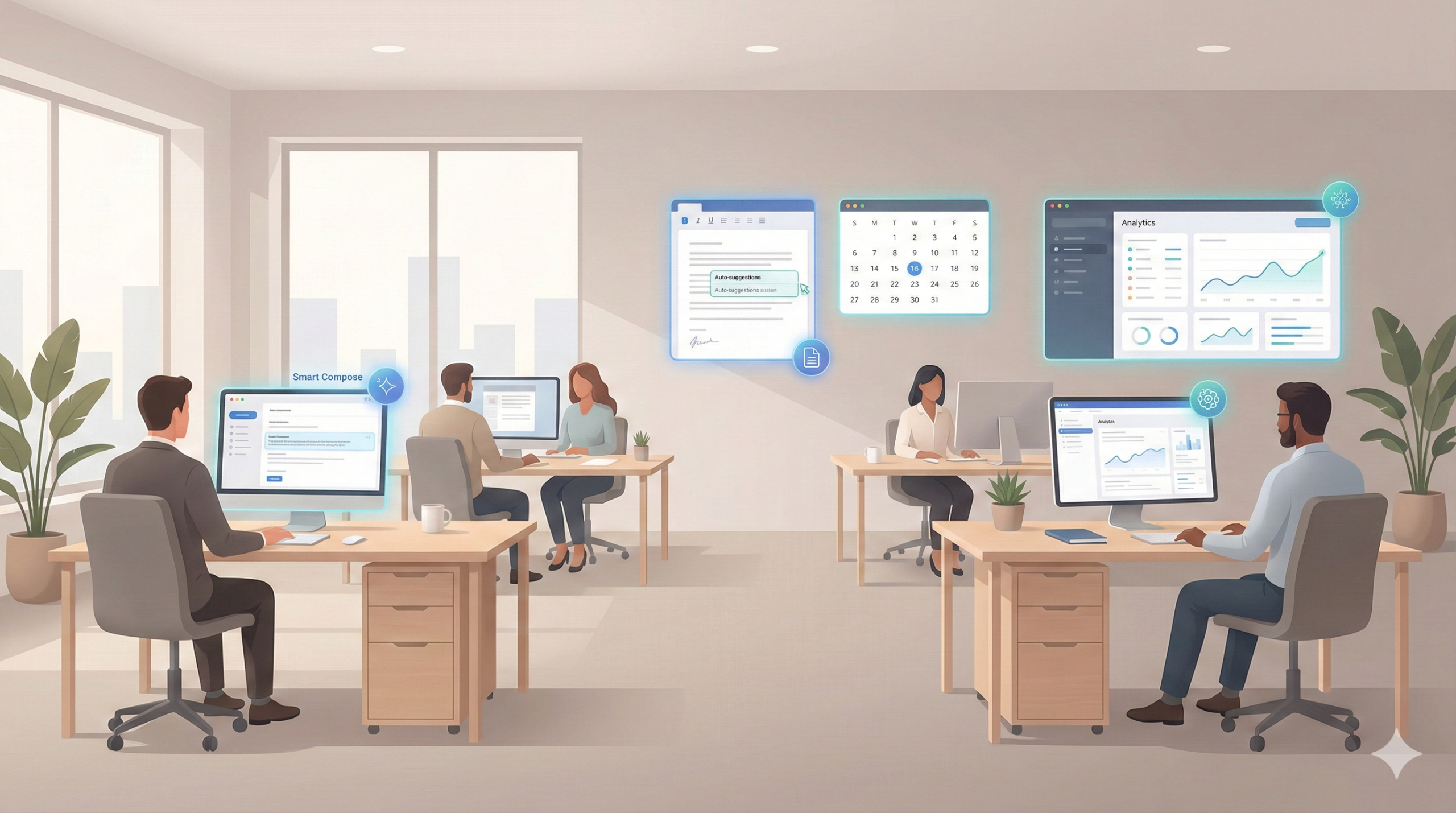
“Boring” doesn’t mean insignificant. It means AI will be increasingly embedded into everyday tools and workflows, to the point where you stop noticing it. You’ll see fewer standalone “AI products” and more features labelled “suggested by AI”, “auto-completed” or “generated for you”.
Email will feel different. Your inbox triage will be largely automated: priority messages surfaced, routine ones bulk-handled, drafts suggested. Meeting summaries will appear automatically in your notes tool, with action lists and owners pre-filled.
Documents and presentations will be co-written. You’ll outline the purpose and audience; the system will propose structures, pull in relevant data, and draft sections. Your job will be to correct, contextualise and decide – not to stare at a blank page.
Customer service will become more asynchronous. Rather than waiting on hold, customers will interact with AI-powered flows that can resolve most issues. Human agents will still be there, but focused on genuinely tricky or sensitive cases. Metrics will shift from average handle time to resolution quality and empathy.
In software development, AI will be everywhere: suggesting architecture options, generating tests, refactoring legacy code. Teams that fully embrace AI pair programming will ship more, with fewer defects. The skill set of an engineer will tilt further towards system design, security and integration rather than repetitive coding.
For SMEs, the line between “IT project” and “business change” will blur. Deploying a new tool will often mean enabling AI features: predictive forecasting in finance, anomaly detection in operations, automated classification in compliance. The challenge will be less about technology per se and more about trust, governance and training.
So what should you actually do to prepare for this “boring AI” year?
First, clean your data. AI features are only as good as the information they have. If your CRM is a mess, your knowledge base is out of date, or your file naming is chaos, AI will amplify confusion. Invest in basic hygiene: standard fields, ownership, and clear locations for key documents.
Second, experiment deliberately. Rather than turning on every AI button you see, pick a handful of workflows where time is genuinely wasted: producing reports, answering common queries, preparing proposals. Pilot AI-supported versions, measure impact, and gather feedback from the people doing the work.
Third, update roles and expectations. If AI takes over 30–40% of the grunt work in a role, what does success now look like? Perhaps it’s deeper client relationships, faster project delivery, or more proactive risk spotting. Be explicit. Otherwise, staff may simply fill freed-up time with low-value busyness.
Fourth, strengthen your ethical and legal guardrails. As AI becomes normal, the risk is not a single catastrophic failure, but lots of small, unnoticed ones: biased suggestions, misfiled records, over-sharing of sensitive data. Make sure someone is genuinely accountable for AI governance – and that they have a budget and authority.
Finally, keep perspective. The tech world will still generate wild claims: fully autonomous companies, AI CEOs, sentient chatbots. Some of it will be marketing, some genuine research, some speculative fiction. Your job is to focus on what moves the needle for your business.
If 2023–2024 were the years of AI novelty, 2026 will be the year AI becomes infrastructure. Quiet, reliable, sometimes invisible – and, for organisations that embrace it thoughtfully, extremely useful.